Kids and teens in mental crisis mode—fact or fiction?
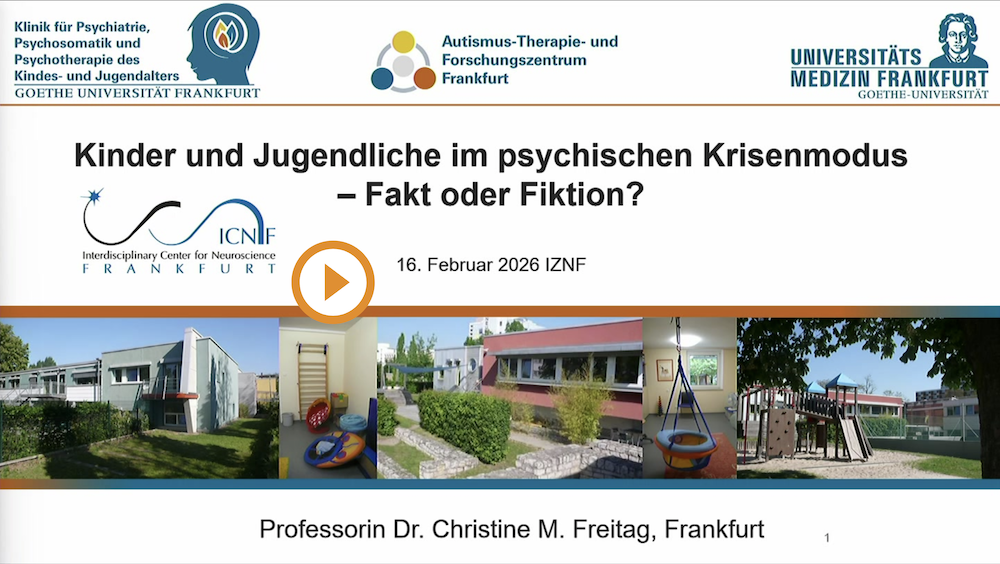
The mental health of children and adolescents has been a hot topic since the SARS-CoV2 pandemic, as depressive episodes, anxiety disorders, and eating disorders have increased significantly during this time, mainly due to the lockdown. Although the symptoms have declined significantly in children and adolescents since the end of the pandemic measures, there are numerous discussions about an increase in mental disorders in children and adolescents, as well as complaints about long waiting times and inadequate care. In her highly engaging and passionate presentation, Prof. Freitag presented current studies on mental health in Germany and critically interpreted them in the context of the long-term trend over the last few decades.
She also highlighted key risk, protective, and resilience factors and discussed an interpretation based on the social development of children and adolescents, with a focus on resources and problem-solving skills.
Frankfurt hat Hirn – live on March 10, 2026
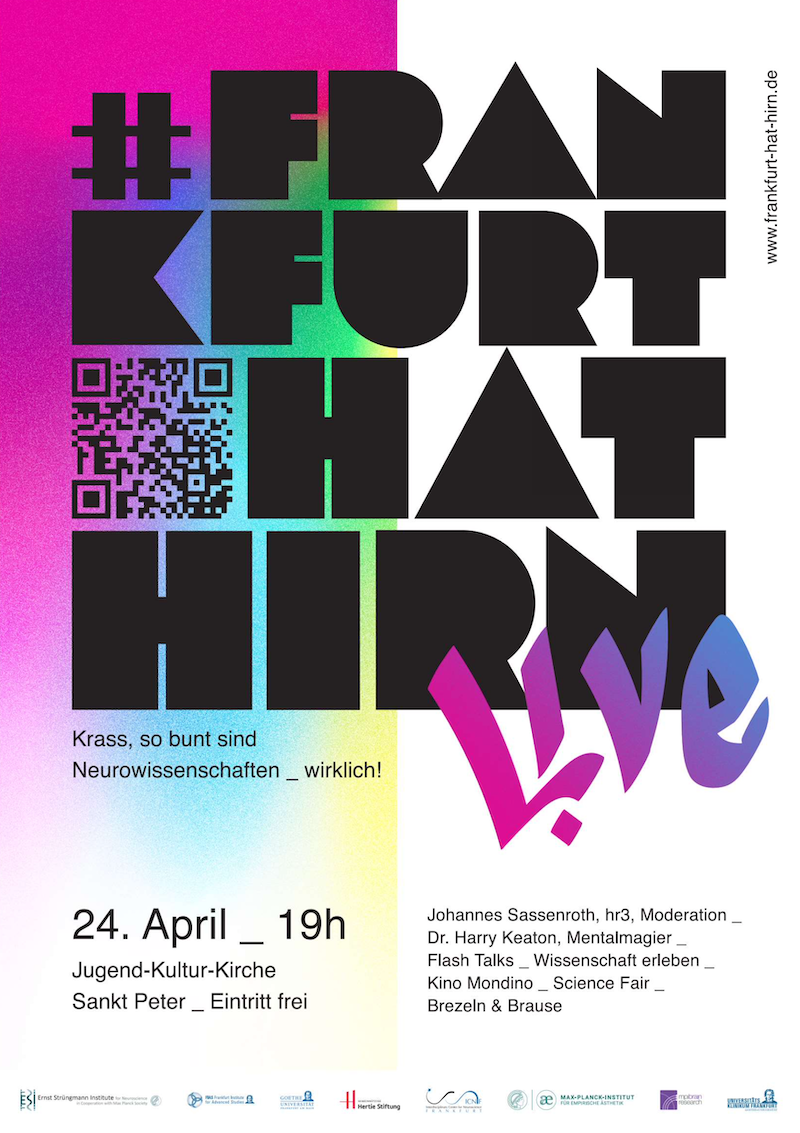
Discover the fascination of the human brain at #Frankfurt hat Hirn _ Live – An evening-long experience that combines science and entertainment. Together with Frankfurt’s neuroscientific institutions, the Hertie Foundation invites you to the Jugend-Kultur-Kirche St. Peter on Wednesday, April 24, 2024.
#Frankfurt hat Hirn _ Live offers deep insights into the world of neuroscience: Whether you are a high school student, university student or curious person – this event invites you to discover the secrets of the brain together.
The program includes a variety of exciting acts: Johannes Sassenroth (hr3) leads through the evening, the brain acrobat and mental magician Dr. Harry Keaton enchants the audience. Impressive ‘Flash Talks’ from the neuroscientific institutions of the Main metropolis offer fascinating insights into current research results. On the big screen, “Dr. Mondino” explains the human brain in a humorous way and at the Science Fair you can get very close to science.
Be there and experience an unforgettable evening in Frankfurt with your friends!
By the way, admission is free 😊
Further information and registration at www.frankfurt-hat-hirn.de
Frankfurt has Brain
How does our brain work? Several international institutions in Frankfurt are trying to find answers to this question: The Interdisciplinary Center for Neuroscience at Goethe University Frankfurt, the Max Planck Institute for Empirical Aesthetics, the Max Planck Institute for Brain Research, the Frankfurt Institute for Advanced Studies, the Ernst Strüngmann Institute have been researching – in some cases for decades – about the brain, while the non-profit Hertie Foundation has been funding neuroscience research since the early 1970s.
In addition to these institutions, the history of the city of Frankfurt also has much to offer: important personalities, events and research results related to neuroscientific topics. Some of these go back to the 19th century and thus spring from the cradle of modern brain research, so to say.
To show how much brain Frankfurt has, the neuroscientific institutions of the Main metropolis have joined forces and present the website “Frankfurt hat Hirn” on the occasion of the international Brain Awareness Week 2021.
Enjoy it!
Internal ICNF mini-symposium
Internal ICNF mini-symposium – presenting, networking, enjoying –
Wednesday, September 27, 2023
at Campus Riedberg, Otto-Stern-Zentrum
register here
find the program here
6. rmn² lecture in Frankfurt
It was exciting to have Prof. Magdalena Götz, an award-winning neurobiologist and a leading figure in stem cell research, for the 6th rmn² lecture in Frankfurt on January 22.
Brain Prize 2023 for Erin Schuman

With the Brain Prize 2023, the Lundbeck Foundation honours the pioneering work of Erin Schuman from the Max Planck Institute for Brain Research in Frankfurt, Christine Holt from the University of Cambridge and Michael Greenberg from Harvard Medical School. The researchers have revolutionised our understanding of how nerve cells regulate the production of the brain’s many thousands of proteins. They have uncovered crucial mechanisms for brain development and function and provided insights into the origins of neurodegenerative diseases and developmental disorders.
CRC 1080 extended
The German Research Foundation (DFG) approves third funding period for the Collaborative Research Centre 1080 Molecular and Cellular Mechanisms in Neural Homeostasis.
The CRC 1080, which started in 2013, has been extended by four years for the second time, so that the funding will continue through to 2024. Goethe University is the coordinator with Prof. Amparo Acker-Palmer as spokesperson. The DFG is providing € 2 million per year for four years of research. In the CRC 1080, scientists from various disciplines investigate how the brain and nervous system maintain stability as a complex system while also remaining accessible and flexible.
A video portrait of the Master program “Interdisciplinary neuroscience”
Students from Riedberg TV show the Master’s program “Interdisciplinary Neuroscience” in a video portrait.
Prof. Dr. Thomas Deller new member of the Leopoldina
Prof. Dr. Thomas Deller, deputy director of the ICNF, was accepted into the Leopoldina – National Academy of Sciences, the oldest scientific-medical scholarly society in the German-speaking area and the oldest permanently existing natural research academy in the world. The Leopoldina elects outstanding scientists from all over the world as its members. They advise politicians and foster exchange with foreign academies and scientists.
A portrait of the Master program “Interdisciplinary neuroscience”
Find here an article about the Master program “Interdisciplinary Neuroscience” published in UniReport 1.19 of Goethe University. PDF for download