
Pleasure with side effects—the influence of nutrition on our brain

Overweight and obesity are on the rise worldwide and threaten not only our physical health but also our mental health. The latest research shows that unhealthy eating has a direct impact on the brain and can alter mood, motivation, and even thought processes. Why do we so often eat more than is good for us? What tricks does the food industry use to exploit our weakness for sugar, fat, and salt? And how are eating habits and mental illness related?
This lecture provided exciting insights into the close connection between nutrition and the psyche—and invited us to look at our habits with new eyes.
Creativity in man and machine
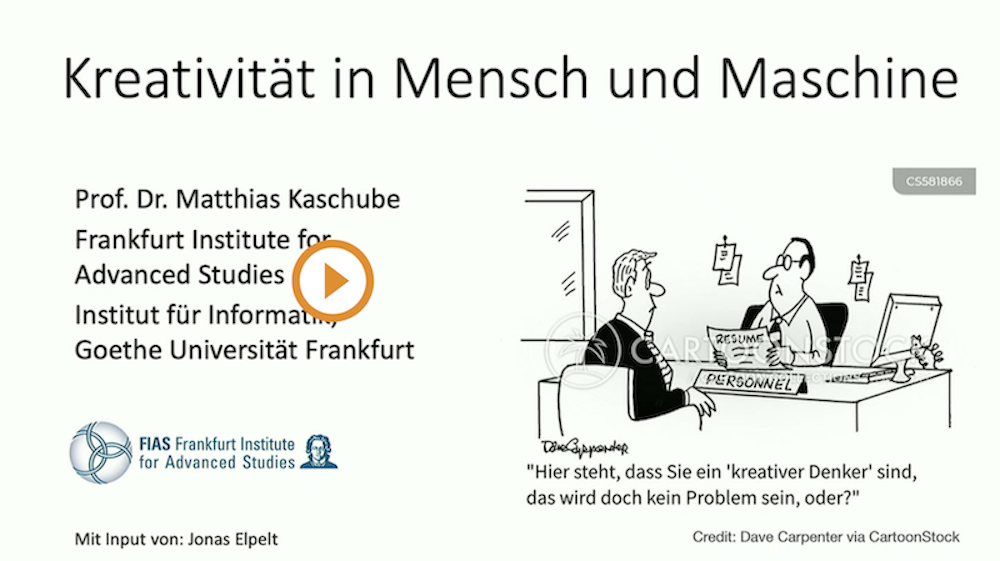
Creativity is one of the most fascinating human abilities and a key driving force behind many cultural and technical innovations. What light does modern neuroscience shed on the phenomenon of creativity? To what extent can artificial intelligence (AI) help us to better understand creativity or to become more creative? And is contemporary AI already as creative as we humans?
In this lecture, Prof. Kaschube used a number of examples to describe the current state of research into these questions. Promising approaches of current research were outlined to better characterize the multifaceted phenomenon of creativity, to make it empirically measurable and to break down the creative process into components that can be investigated neuroscientifically – which also helps to better understand the creative potential of AI.
Internal ICNF mini-symposium
Internal ICNF mini-symposium – presenting, networking, enjoying –
Wednesday, September 27, 2023
at Campus Riedberg, Otto-Stern-Zentrum
register here
find the program here
6. rmn² lecture in Frankfurt
It was exciting to have Prof. Magdalena Götz, an award-winning neurobiologist and a leading figure in stem cell research, for the 6th rmn² lecture in Frankfurt on January 22.
Prof. Dr. Jochen Triesch coordinator of „Computational Connectomics”
Prof. Dr. Jochen Triesch (ICNF’s executive committee member, Frankfurt Institute for Advanced Studies, Goethe University Frankfurt) is coordinator of the new Priority Programme (PP) Computational Connectomics. The young field of connectomics enables the production and study of detailed maps of connections within an organism’s nervous system at unprecedented scale and precision.
Materialien zum Vortrag von Prof. Singer
Vortragsfolien und Audio-Mitschnitt des Vortrags von Prof. Wolf Singer im Rahmen der 1. rmn² lecture
ERC Advanced Grant for Amparo Acker-Palmer
How do neurons and blood vessels “talk” to each other? Neurobiologist Amparo Acker-Palmer receives an ERC Advanced Grant of 2.5 Mio Euros for 5 years.
Bernstein Award 2013 for Hermann Cuntz
Ernst Strüngmann Institute for Neuroscience in Cooperation with Max Planck Society, Frankfurt and Frankfurt Institute for Advanced Studies, for his investigations on the structure of neuronal connections
ERC Starting Grant for Ilka Diester
Ilka Diester (Bernstein Award 2012, Ernst Strüngmann Institute, Frankfurt) receives an ERC Starting grant for her project “Optogenetic dissection of motor cortex dynamics and pathways”.